Complete Guide: Calculating the Vehicle Benefit-in-Kind in 2025
The vehiclebenefit-in-kind is a key consideration for companies that provide company cars to their employees. It is calculated using two distinct methods: the flat-rate method and the actual-expense method.
Until now, many companies have favored the simplicity of the flat-rate system. But since 2025, tax reform has changed the game: the significant increase in flat-rate tax rates has drastically altered the balance between these two methods. Now more than ever, it is crucial to analyze the financial and strategic implications of each option in order to optimize decisions and minimize the tax burden for both the company and the employee.
- AEN, New
Table of Contents
The Flat-Rate Assessment Method: Simplicity and New Rates for 2025
Of the two available options, this approach stands out as the simplest to implement and, as a result, the one most widely used by companies.
For a vehicle purchased
Effective immediately, for this category of vehicles, the new rates are set at 15% of the purchase price (including tax) for vehicles less than 5 years old, and 10% for vehicles over 5 years old.
These rates are accompanied by a fuel allowance ranging from 20% to 15%.
For a leased vehicle (long-term lease/lease-to-own)
With the 2025 reform, the rules for calculating the flat-rate benefit for a vehicle under a long-term lease (LTL) or a lease-to-own agreement (LTO) are changing significantly. Without employer-provided fuel: the benefit in kind is now set at 50% of the vehicle’s total annual cost (including lease payments, maintenance, and insurance). With fuel costs covered by the employer: the rate increases to 67% of the total annual cost.
These percentages, which are significantly higher than the previous rates, increase the tax impact for both the company and the employee.

Example of a flat-rate calculation
Let’s look at a specific example to illustrate this increase: An employee has access to a company car under a long-term lease agreement valued at €30,000.
Before 2025, the flat-rate assessment was 9% of the purchase price, amounting to €2,700 in annual benefits in kind (excluding fuel).
In 2025, with the new rates, the valuation rises to 50% of the total annual cost. Assuming the total annual cost (lease + maintenance + insurance) is €6,000, the benefit in kind now amounts to €3,000 excluding fuel, and €4,020 if the employer covers the fuel costs.
Result: For an identical vehicle, the employee’s taxable benefit in kind increases, making a comparison with the actual-cost method all the more strategic.
Actual Expenses: Accuracy and Potential for Optimization
Unlike the flat-rate method, the actual-expense method is based on a detailed analysis of all vehicle-related costs. Although it is more demanding in terms of tracking and documentation, it may become particularly advantageous in 2025, especially given the significant increase in flat-rate rates. By choosing this approach, the company and the employee can better align the value of the Fringe Benefit with the actual use of the vehicle, thereby reducing the tax burden.
What expenses should be included in the calculation?
For a purchased vehicle:
Depreciation of the purchase price (20% per year for the first 5 years, then 10% thereafter),
Insurance,
Maintenance fees, including tax.
For a leased vehicle (long-term lease or lease-to-own):
Total rental cost,
Maintenance,
Insurance.
All of these costs form the basis for calculating the mileage-based prorated amount.
The actual mileage calculation formula (pro-rata by mileage)
The value of the benefit in kind is calculated using the following formula:
Total annual cost of the vehicle × (Personal mileage ÷ Total mileage)
In addition to this amount,fuel costs related to personal use are included, if applicable, provided that the employer covers these costs.
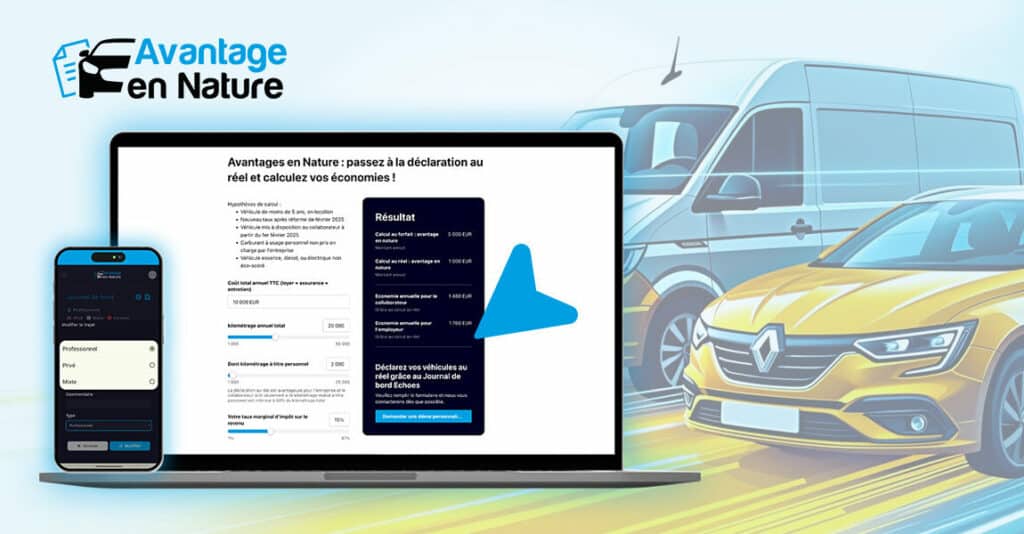
To learn more, use our simulator to calculate your 2025 car benefit in kind in just a few clicks and find out which plan is best for you.
The Importance of Traceability
The main challenge with this method lies in providing proof of personal mileage. To qualify for the prorated calculation, employees must keep an accurate logbook (or use another tracking tool) that clearly distinguishes between business and personal trips.
Without documented proof, URSSAF may automatically apply the flat-rate calculation, which will often be less favorable in 2025.
Fixed-Rate vs. Variable-Rate: How to Choose the Best Plan in 2025?
The 2025 reform marks a major turning point: with a nearly 67% increase in flat rates, the method that had previously seemed the simplest and most common is now much less advantageous for many vehicles. This change is a game-changer and is forcing companies to reevaluate their strategy for calculating the benefit in kind.
To minimize their payroll and tax liabilities, employers would be well advised to run simulations using both methods for each vehicle provided to their employees. Depending on the vehicle’s value, the financing method (purchase or lease), mileage, and whether it is used for business or personal purposes, the difference can be significant.
Good news: the company isn’t locked into its choice. Employers can revise their decision at the end of the fiscal year for the previous year in order to select the most favorable method. This flexibility helps limit the impact of the reform and allows for a case-by-case adjustment of strategy.
As a result, the flat-rate option is certainly simpler, but it is more expensive. On the other hand, the actual-cost method is more restrictive, but it offers much greater potential for savings since the tax reform. If you’d like to learn more about benefits in kind, check out the Complete Guide to Vehicle Benefits in Kind.
In summary, here is the checklist to help you choose between the two options in 2025:
- Compare the two methods: calculate the benefit-in-kind using the flat-rate method and the actual-cost method for each vehicle.
- Analyze actual usage: the more the vehicle is used for business purposes, the more the actual-usage method may be worthwhile.
- Assess traceability: Can you accurately document personal mileage (logbook, tracking app, etc.)? If not, the flat rate will apply.
- Take advantage of the flexibility: remember that you can adjust your choice at the end of the fiscal year to select the most advantageous option.
FAQ: What You Need to Know to Reduce Your TCO
Why is TCO often underestimated?
Many companies consider only direct costs of a vehicle, such as purchase or fuel.
The indirect costs — such as downtime, administrative burden or depreciation — are often overlooked, even though they have a significant impact on the overall cost.
How does digital management work without additional hardware?
Digital management uses OEM data (manufacturer data), extracted directly from the vehicle's built-in telematics of the vehicle.
Systems based on cloud and API enable seamless integration with existing software, without the need to install GPS trackers or sensors.
How does digital management actually help reduce TCO?
Thanks to real-time data analysis and process automation, companies can:
- Reduce maintenance costs by responding quickly to errors or wear and tear
- Reduce fuel or energy costs through driving analysis and optimized usage
- Reduce the administrative burden through digital logbooks and automated billing
- Avoid downtime by proactively planning repairs and maintenance
Does the vehicle tax affect the total cost of ownership?
Yes, vehicle taxation can have a significant impact on the TCO, particularly for large fleets.
Factors affecting vehicle taxation:
- CO₂ emissions : Clean vehicles are often given tax breaks
- Vehicle type : Electric vehicles are eligible for tax benefits in many countries
- Engine displacement and power : powerful vehicles are generally subject to higher taxes
Choosing the right vehicles therefore helps to not only reduce operating costs, but also enjoy tax benefits.