




Echoes

Telematics API for Connected Vehicles: A Comprehensive Guide and Use Cases

The future of corporate mobility hinges on data. A telematics API allows you to connect your information systems directly to vehicles, without the need for physical devices. Echoes provides a single gateway to centralize data flows from your connected vehicles, optimizing every aspect of your fleet management.

Maintenance 1 dark blue with blue accents

Optimization of operating costs

Reduce expenses related to equipment and installation, while gaining a more detailed understanding of each vehicle’s actual fuel consumption.

Maintenance 2: dark blue with blue accents

Proactive maintenance

Receive fault codes and maintenance alerts directly from the engine to prevent more serious breakdowns.

Thumbs up, dark blue with blue accents

Real-time tracking

Track the location of your assets to minimize downtime and optimize delivery routes.

Key Features and Practical Applications

The Echoes API enables the instantaneous reporting of critical metrics: fuel level, battery charge status (EV), manufacturer-certified mileage, and precise geolocation.

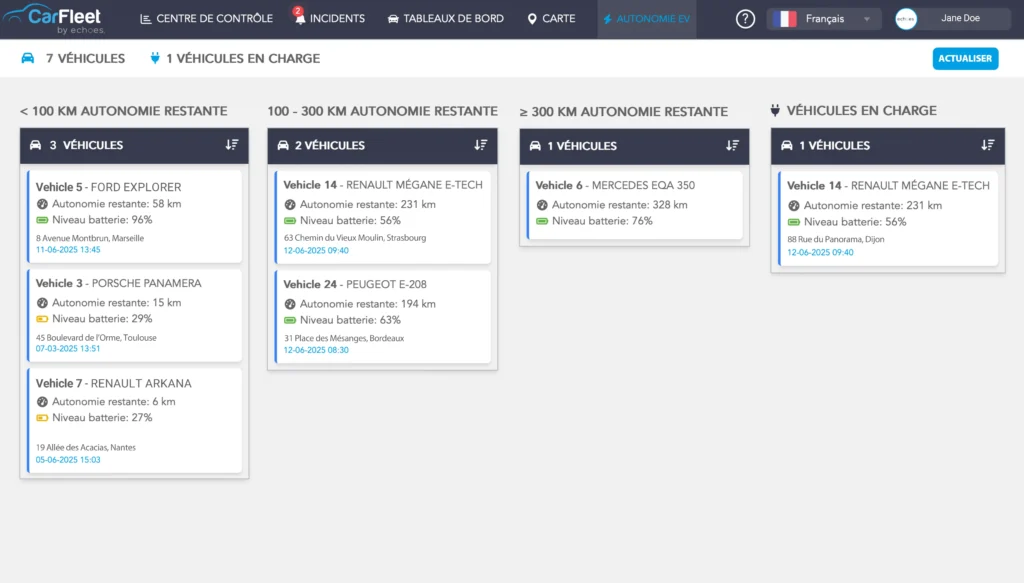
Use API data to intelligently manage the charging of your electric vehicles. Schedule charging sessions based on electricity rates and streamline the deployment of car-sharing solutions.

Real-time vehicle data

Optimization of electric vehicles

Development of new services

Security and GDPR Compliance

Data Security and Privacy Issues

Data Protection and Compliance

We guarantee that data collection complies with European regulations (GDPR). The use of secure APIs minimizes physical vulnerabilities associated with devices connected to the OBD port.

How do you choose the right telematics API?

Your API must meet three criteria: compatibility across manufacturers, scalability to add new vehicles without requiring major technical changes, and access to clear developer documentation with expert support.

Oneof Echoes’ key strengths is that the solution is consistent across our entire fleet, regardless of the vehicle model. We always know where it is, its condition, and what actions to take. This cross-functional approach is a real asset.”

Director of Fleet Engineering at Europcar, a company that uses Echoes

Data that could be useful to you

vehicle information

VIN, make, model, year, color, fuel type, transmission type

Fuel consumption & EVs

Vehicles charging, battery charge level, date of last charge, state of charge, fuel level and consumption, low fuel alert, CO2 emissions...

detailed itineraries

Departure location, arrival location, travel time

telemetry

Odometer reading, mileage, engine condition, engine oil temperature, AdBlue level...

GPS tracking

Real-time tracking, start alerts, geofencing, interactive map...

Maintenance

Maintenance due dates, mechanical alerts…

What is a telematics API?

A telematics API is a software interface that enables different applications to communicate with one another to exchange vehicle data. It queries the original manufacturer-installed modem directly, standardizing raw data from various manufacturers.

The Role of APIs in the Connected Ecosystem

leasing companies

Centralise your vehicle data and monitor your entire fleet in real time.

rental companies

Track and manage your rental fleet using manufacturer data.

logistics and transportation

Optimise routes, manage driver behaviour and monitor vehicle condition.

corporate fleets

Manage your company fleet efficiently from a single platform.

Frequently Asked Questions (FAQ)

1. What are the costs associated with using a telematics API?
Unlike hardware-based solutions, there are no costs associated with purchasing or installing a device. The model typically relies on a pay-as-you-go subscription, which is far more cost-effective for modern fleets.
2. Can an API be used with non-connected vehicles?
No, the API requires the vehicle to have a factory-installed modem. For older vehicles, a hybrid solution may be considered, but the future of fleet management lies in native integration.