How to Install a GPS Tracker in a Fleet? (The Advantage of Not Doing So)
Are you looking for a guide on how to install a GPS tracker in your fleet? What if the best guide showed you how to avoid it altogether?
Installing a traditional GPS tracker raises many questions: Who installs it? How long will the vehicle be out of service? Is it reliable? And most importantly, is there a simpler and more effective alternative?
In this article, we address these questions and introduce you to a revolution in fleet tracking: the plug-and-play GPS tracker. A solution that eliminates the hassle while providing richer and more secure data.
New
Table of Contents
The "traditional" method: Installing a GPS unit in a vehicle
The traditional steps
Choosing a case: Select a model that meets your needs (battery life, accuracy, connectivity).
Connection: Connects to the battery or the OBD (On-Board Diagnostics) port.
Installation: Hire a professional to avoid mistakes, which entails additional costs and keeps the vehicle out of service.
Setup: Configure the system to send data to your management platform.
The major drawbacks
Risk of theft or vandalism: A visible housing can be spotted and ripped off by thieves.
Impact on the manufacturer's warranty: Improper installation may void the vehicle's warranty.
Logistical complexity: For a fleet of 20 or more vehicles, the installation becomes an organizational headache.
Limited data: Generally, only the location is tracked, with no access to the vehicle's technical data.
The "zero-installation" revolution: OEM telematics
The concept
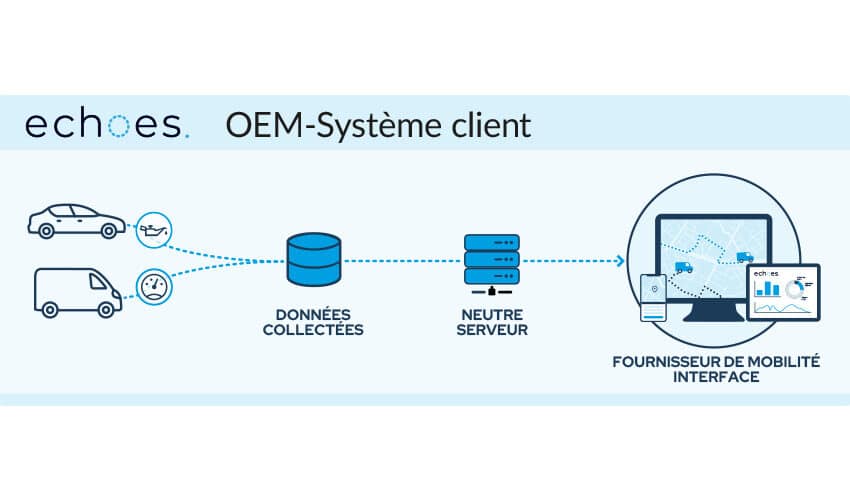
Modern vehicles are already equipped with GPS chips and modems installed by the manufacturer. These systems transmit accurate real-time data on the vehicle’s location, condition, fuel consumption, and much more.
Solutions like Echoes leverage this data without requiring any physical setup. All that’s needed is authorization from the manufacturer to access this information directly from the cloud.
Key Benefits
No downtime: No need to park vehicles during installation.
Highly reliable data: The information comes directly from the vehicle's onboard system, with no risk of tampering.
Complete discretion: Cannot be detected or disabled by malicious third parties.
Comprehensive data: Access to detailed information (mileage, fuel level, maintenance alerts, driving style, etc.).
Cost savings: No installation, maintenance, or replacement costs for damaged enclosures.
Installing a GPS Tracker in Your Fleet: What If You Didn’t Have to Do It?
Criterion
GPS unit to be installed
No-installation solution (OEM)
Installation
Complex (professional required)
Non-existent
Data reliability
Good
Excellent (raw data)
Discretion (anti-theft)
Low (visible)
Total (invisible)
Data richness
Limited (position)
Complete (fuel, mileage, maintenance, etc.)
Fixed assets
Yes (several hours)
No
The era of "zero installation" has arrived
The days of having to “tinker” to keep track of your fleet are over. Installation-free solutions, such as manufacturer-provided telematics, offer a simpler, safer, and more effective alternative. Choosing an installation-free solution means opting for:
Simplicity: No more logistical hassles.
Security: Data that is protected and invisible.
Performance: Access to comprehensive information for optimized management.
What about you? Are you ready to move into the era of tracker-free tracking?