Multi-brand fleet management: the challenge of data consolidation
A daily headache for fleet managers
“One dashboard for your Peugeots, another for your Renaults, an Excel file for your Mercedes, and maybe even a paper logbook for the oldest vehicles… Does this sound familiar?” For companies managing a fleet of vehicles from different manufacturers, data fragmentation is a daily reality. Each manufacturer offers its own tracking tools, specific reports, and dedicated interfaces. The result: information silos that make comprehensive analysis complex, if not impossible.
Why is this a problem?
- A waste of time: Managers spend hours manually compiling scattered data.
- Risk of errors: The proliferation of sources increases inconsistencies and omissions.
- Suboptimal decisions: Without a comprehensive overview, it is difficult to identify opportunities for cost savings or improvements.
Fortunately, there’s a solution that brings all your vehicles together under one digital roof, regardless of their make. Discover how to turn this complexity into a strategic opportunity.
Summary:
The Problem with Native Manufacturer Platforms: Why They Aren't Enough
Each automaker has developed its own fleet management platform:
- Renault offers its telematics portal,
- Peugeot and Citroën use connected tools via Free2Move,
- BMW and Mercedes have their own dedicated systems (BMW ConnectedDrive, Mercedes Me),
- Toyota and Volkswagen are not to be outdone, with their own solutions.
The major limitations of this approach
- No consolidated financial statements:
- Each platform covers only vehicles of its own brand.
- It’s impossible to get an overview of the entire fleet without tedious manual work.
- No objective comparison:
- Performance metrics (fuel consumption, costs, maintenance) are not standardized across brands.
- It's hard to say which model or driver performs best.
- Increasing number of interfaces and credentials:
- A fleet manager must log in to several portals, each with its own login credentials.
- This increases the risk of data loss or data entry errors.
- Lack of flexibility:
- Manufacturer platforms are rarely compatible with one another.
- Adding a new brand to the fleet often means having to learn a new tool.
Result: Time-consuming, inefficient, and frustrating fleet management.
The solution: An independent aggregation platform for unified management
A universal hub to centralize all your data
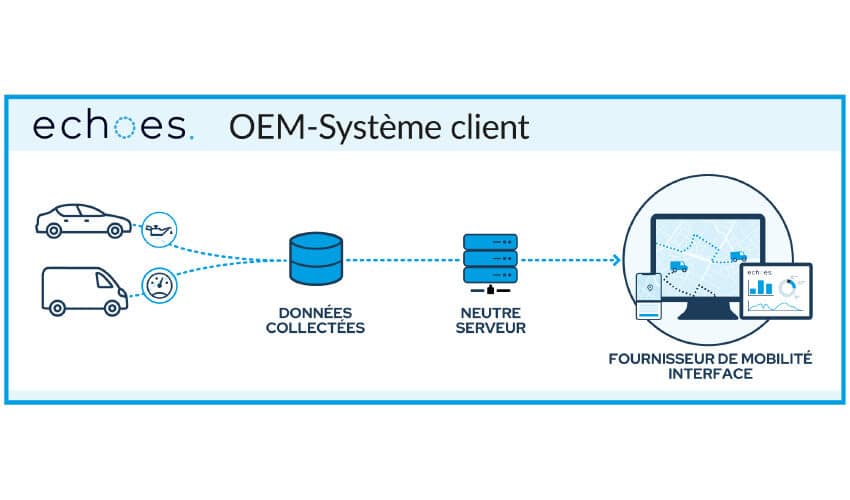
Imagine a solution capable of collecting, standardizing, and displaying data from all your vehicles—regardless of their make—on a single interface. That’s exactly what Echoes offers: a platform designed for multi-brand fleets.
How does this centralization work?
- Integration with manufacturers' APIs:
- Echoes connects directly to the manufacturers'official APIs (Peugeot API, BMW Connected, Renault Telematics, etc.).
- Data is retrieved in real time and automatically updated.
- Data standardization:
- The data is standardized to allow for objective comparisons.
- For example, fuel consumption is expressed in the same unit for all vehicles.
- A single, intuitive interface
- No more switching between multiple portals: everything is accessible from a single dashboard.
- Managers become more efficient and feel more at ease.
The Tangible Benefits of a Unified View: Why It Makes All the Difference
1. Comprehensive and real-time reporting
With a unified platform, you can access key metrics for your entire fleet with just one click:
- TCO (Total Cost of Ownership): Compare the actual costs of each vehicle, regardless of the make.
- Average fuel consumption: Identify the most fuel-efficient models and the driving habits that can be improved.
- CO₂ Emissions: Track your fleet’s environmental impact and adjust your CSR strategy.
Example: A manager may notice that the Peugeots in their fleet consume 10% less fuel than the Renaults, and adjust future purchases accordingly.
2. Standardized KPIs for objective comparisons
- Vehicle Performance: Compare the reliability, maintenance costs, and lifespan of different models.
- Driver Behavior: Assess driving styles and identify necessary training, regardless of the vehicle make.
- Cost optimization: Identify potential savings (fuel, insurance, maintenance) through a cross-functional analysis.
Case Study: A company reduced its fuel costs by 15% by identifying the drivers with the highest fuel consumption, regardless of the vehicle they were driving.
3. Centralized alerts for proactive management
- Maintenance: Receive notifications for scheduled maintenance, manufacturer recalls, or potential breakdowns.
- Safety: Get alerts when risky driving behavior is detected (speeding, sudden braking).
- Compliance: Keep track of deadlines (vehicle inspection, insurance) so you don't miss a thing.
Advantage: No need to check multiple email accounts or portals—all alerts are consolidated in one place.
4. Significant time savings for managers
- No more wasting hours compiling data manually.
- Fewer errors thanks to automation and centralization.
- More time for strategic analysis: The manager can focus on optimization rather than on gathering information.
Testimonial: “Since we started using Echoes, we’ve cut the time spent on administrative tasks related to our fleet by 30%.” — Logistics Manager, transportation company.
Rethink your fleet management with a unified approach
A fleet’s performance is not measured by the quality of its vehicles, but by the manager’s ability to maintain a clear and comprehensive overview. A multi-brand fleet should no longer be a hindrance, but rather an opportunity for optimization and simplification.
Free yourself from complexity:
- Centralize your data for seamless management.
- Compare the performance of your vehicles objectively.
- Manage your fleet with comprehensive, unified data.
With Echoes, fleet management becomes simple, efficient, and strategic. Why not take back control of your fleet today? Request a personalized demo.