The Budget has made mileage a finance question
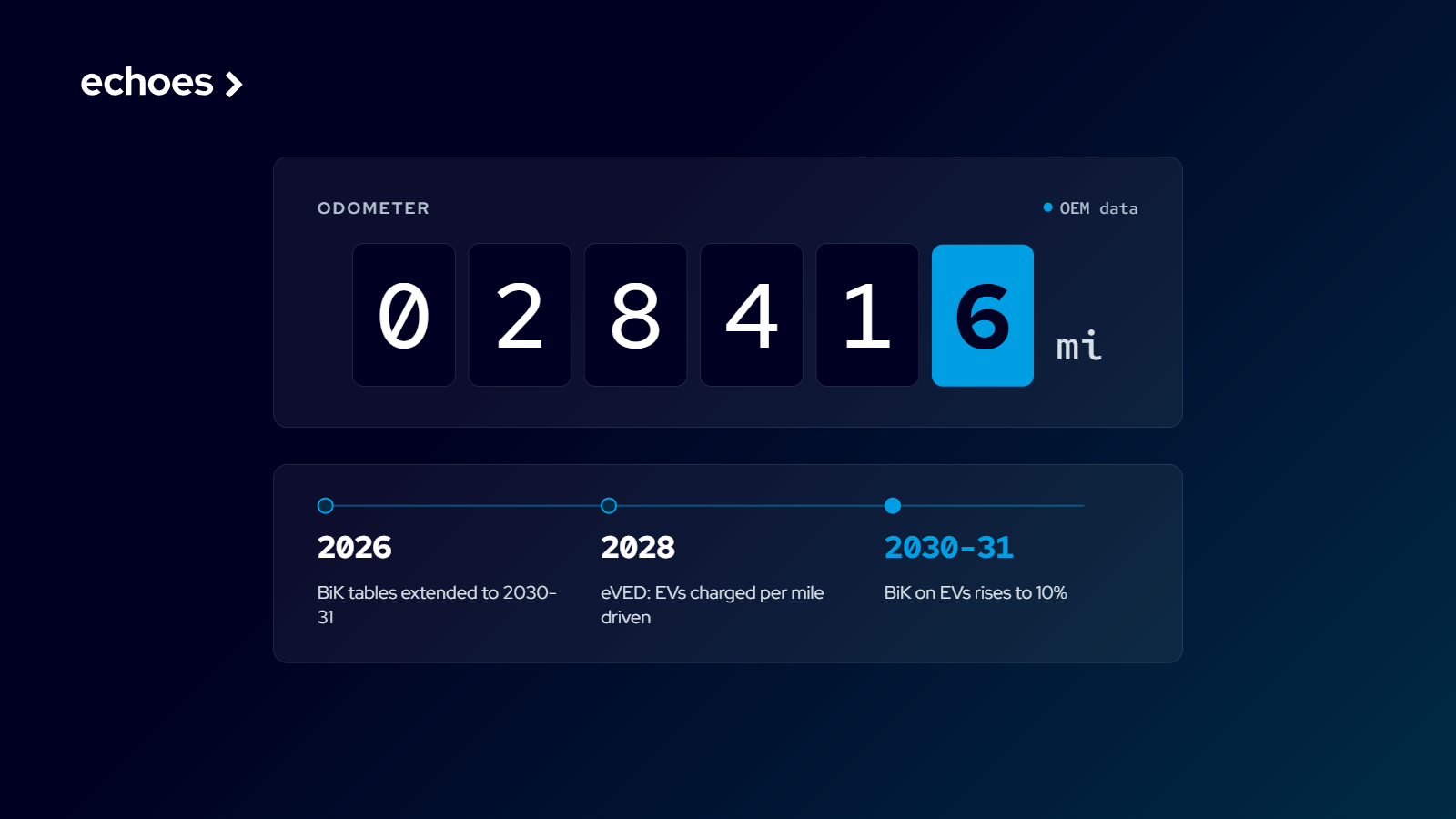
For years, a company car’s mileage mattered mainly at the end of the lease. After the 2026 Budget, it matters to tax planning, to forecasting and to the way fleets will be charged for electric vehicles from 2028.
The Association of Fleet Professionals responded within a day with a six-point checklist for fleet managers. The Fleet Magazine’s coverage, AFP six-point checklist: BiK rises to 10% in 2030-31, is the clearest summary we have read of what fleets now need to recheck.
One theme runs through most of those six points: fleets will need accurate, verifiable mileage data, and they will need it sooner than many expect.
What changed for fleets
Three measures stand out for anyone running company cars or vans in the UK.
- BiK out to 2030-31. The benefit-in-kind tables now run to 2030-31, with the rate rising to 10% in that final year. On a £35,000 electric company car, that is a £3,500 taxable benefit: £700 a year for a basic-rate taxpayer and £1,400 for a higher-rate one, as The Fleet Magazine sets out.
- eVED from 2028. Electric vehicle excise duty, a charge based on miles driven, is going ahead with no changes to the latest proposals. The AFP’s advice is to treat the 2028 start date as fixed.
- Grey fleet pressure. Higher Approved Mileage Allowance Payment rates could nudge some employees towards older, less efficient private cars for business journeys, which runs against most fleets’ electrification plans.
Add Euro 7 replacement timing and a harder question over plug-in hybrid running costs, and the planning horizon for most fleets has just moved out by several years.
Why mileage data matters more now
Mileage used to be a number a driver reported, or a figure read off the odometer when the car went back. That is no longer good enough, for three reasons.
First, it is becoming a tax input. Under eVED, the AFP points fleets towards mileage capture, telematics capability and odometer verification well before 2028. A figure that cannot be checked will be hard to defend.
Second, it is a contract input. Every leased vehicle carries a mileage allowance. A car heading over it means excess mileage charges at the end of the lease; a car running well under it means paying for an allowance the business does not use. Both are cheaper to fix mid-contract than at handback.
Third, it is a forecasting input. Finance teams rebuilding 2027-28 forecasts and BiK projections to 2030-31 need to know how the fleet is actually being used, not how it was specified three years ago.
The catch is that mileage alone tells you very little. It becomes useful when it sits next to the lease terms, the service history and the invoices for that vehicle. In most fleets, those records live in different places.
Where Echoes Fleet Agent fits
That gap is the reason we built Echoes Fleet Agent, launched on 27 October 2026. The Fleet Magazine covered the launch in Echoes launches Fleet Agent linking OEM data to leases, and in its AFP piece noted that fleets already doing this kind of data matching will start eVED preparation ahead.
Fleet Agent is an AI-enabled fleet management agent. It brings mileage and vehicle alerts, taken directly from the manufacturer, into one view with lease terms, workshop invoices and fleet administration records. In practice it:
- compares actual mileage with each lease allowance and flags vehicles heading over or well under it
- surfaces manufacturer alerts for services due or overdue
- places workshop invoices next to mileage and service history, so unusual spend stands out
- records the savings your team achieves through Smart Money, totalled by month and year for finance colleagues
Because the data comes from the vehicle’s own connected systems, compatible cars and vans need no telematics box or dongle. Native connections cover nearly 40 brands, including Mercedes-Benz, BMW, Ford, Kia, Nissan, Vauxhall and Volkswagen, with Polestar the latest addition.
As Michael Higginbottom, Sales Director UK & IE at Echoes, put it at launch: “A mileage reading becomes much more useful when it sits next to the lease allowance and service history.”
Five things to do before 2028
- Extend your BiK forecasts to 2030-31 and revisit the case for salary sacrifice.
- Check which of your vehicle brands can share data natively before budgeting for new telematics hardware.
- List every vehicle currently over or under its lease mileage allowance, and raise contract changes while they are still cheap.
- Compare grey fleet mileage claims with the new AMAP rates, and test whether a managed alternative now costs less.
- Decide how you will capture and verify mileage for eVED, and who in the business owns that data.
Start with the data you already have
Most fleets already own the data they need for 2028. It sits in the vehicles, the lease contracts and the workshop invoices; it simply is not in one place yet.
If you want to see what that looks like for your fleet, book a demo of Echoes Fleet Agent.
For independent, practical coverage of Budget measures, tax changes and running costs for UK vans, trucks and company cars, we recommend following The Fleet Magazine and signing up for its free weekly newsletter.
Sources
- The Fleet Magazine, AFP six-point checklist: BiK rises to 10% in 2030-31, 1 November 2026
- The Fleet Magazine, Echoes launches Fleet Agent linking OEM data to leases, 27 October 2026
- Association of Fleet Professionals, six-point checklist in response to the 2026 Budget