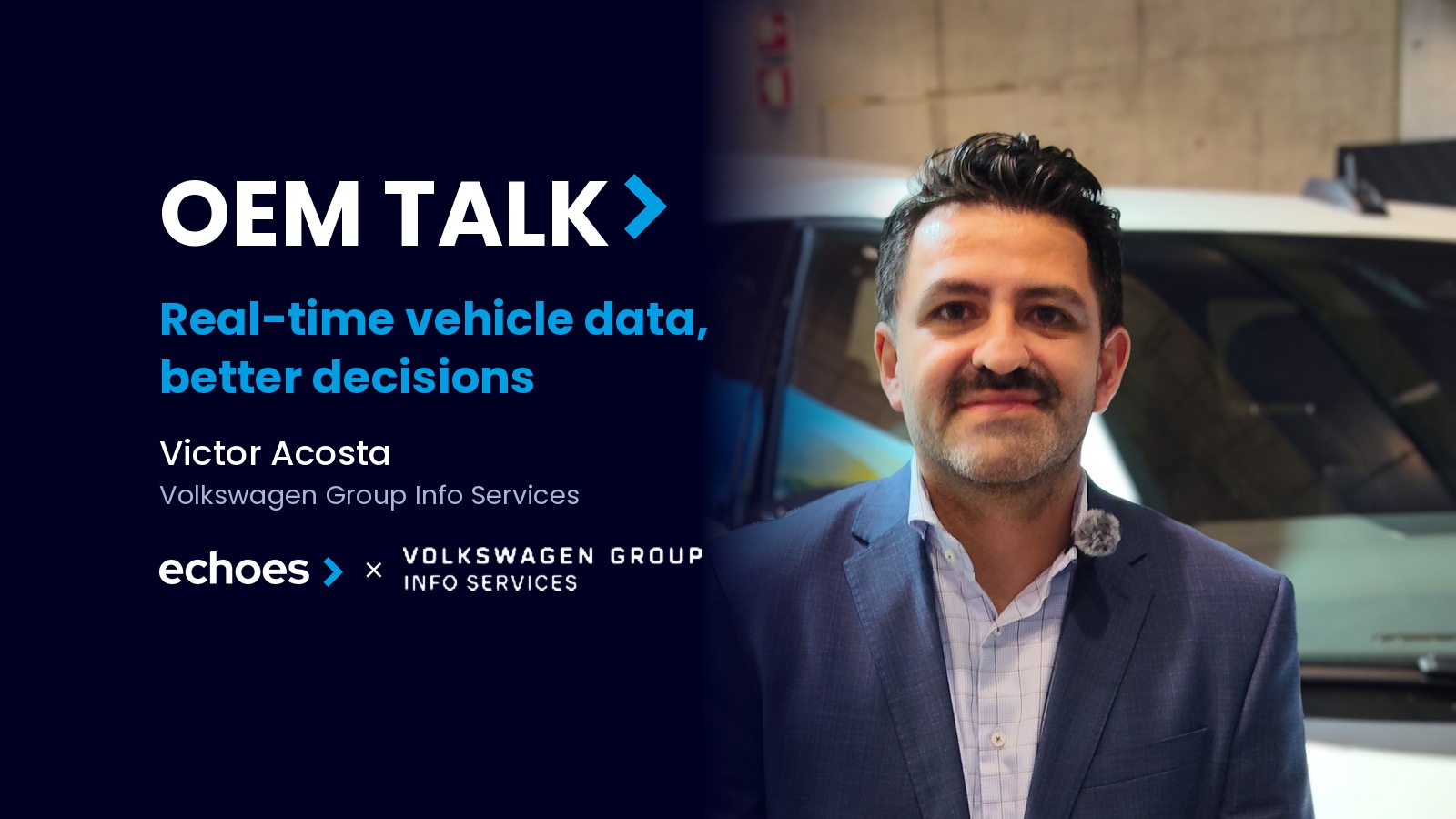
Fleet managers want to know what their vehicles are doing now, not at the end of the month. At Fleet Europe Days in Lisbon, we asked Victor Acosta of Volkswagen Group Info Services how fleet expectations around vehicle data have changed, and where connected services go next.
Victor is Senior Sales Manager for Vehicle & Fleet Data at Volkswagen Group Info Services AG, the Volkswagen Group business responsible for connected-vehicle data. He works with the companies that turn that data into services for fleets, which gives him a clear view of what fleet customers are asking for.
Here is what he told us, lightly edited for reading.
How have fleet customers’ expectations around vehicle data changed?
Victor’s answer was short and clear: fleets want the data live, and they want it from the source.
“The expectation of fleet managers, and also fleet coordinators, at the moment is to access real-time data from the vehicle, from the OEM, in order to track costs and security measures for their fleets.”
A few years ago, many fleets were content with monthly reports and the odd mileage reading. Today the questions are more immediate. Where is the vehicle? What is it costing us this week? Is it secure? Those questions need an answer while there is still time to act on it.
Why are connected vehicle services becoming more important?
For Victor, it comes down to what real-time data lets a fleet do differently.
“Customer expectations with real-time data are to be faster, more efficient, and make better decisions in the fleet management world.”
Speed is the part that is easy to overlook. Knowing about a fault, a cost spike or a security issue the same day changes the decision a fleet manager makes. That matters to the fleet, and it matters to manufacturers too, because it is a reason for business customers to stay close to the brand after the vehicle is delivered.
Which connected services could make the biggest difference next?
Victor pointed to one use case in particular: predictive maintenance built on OEM data.
“The biggest difference that can be made to fleet managers: for example, predictive maintenance based on OEM data, because today customers want to be faster and not bigger. They want to be not only efficient in fleet management, but enhanced fleet management.”
The idea is simple. A fleet that knows a vehicle needs attention before it breaks down can plan the workshop visit, avoid the roadside call-out and keep the vehicle earning. Data that comes straight from the manufacturer’s own systems is what makes that kind of early warning reliable.
What does Echoes bring to the partnership?
We asked Victor what Echoes brings, and how that helps fleet customers.
“Echoes is a great partner of Volkswagen Group Info Services, by helping the transformation and sharing the vision of OEM data without dongle solutions.”
In another take, he put it more broadly: Echoes is transforming the fleet management world, making things more efficient and more secure, and is aligned with the mission and vision of sharing OEM data.
That shared vision is the heart of it. Echoes was built on OEM data from day one, with no boxes to fit and no hardware to maintain. For a fleet running Volkswagen Group vehicles, that means data from the vehicles they already own, available in the same platform as the rest of their fleet.
What this means for your fleet
Victor’s answers point the same way as our earlier conversations in this series. Fleets want real-time data, they want it straight from the manufacturer, and they want it to help them decide faster.
That is what Echoes was built for. We bring OEM data from nearly 40 vehicle brands, Volkswagen Group brands included, into one platform, with no hardware to install. With Echoes Fleet Agent, we now add contracts and costs on top, so that data turns into decisions.
Our thanks to Victor and the Volkswagen Group Info Services team for joining us in Lisbon.
Want to see what OEM data can do for your fleet? Talk to our team.