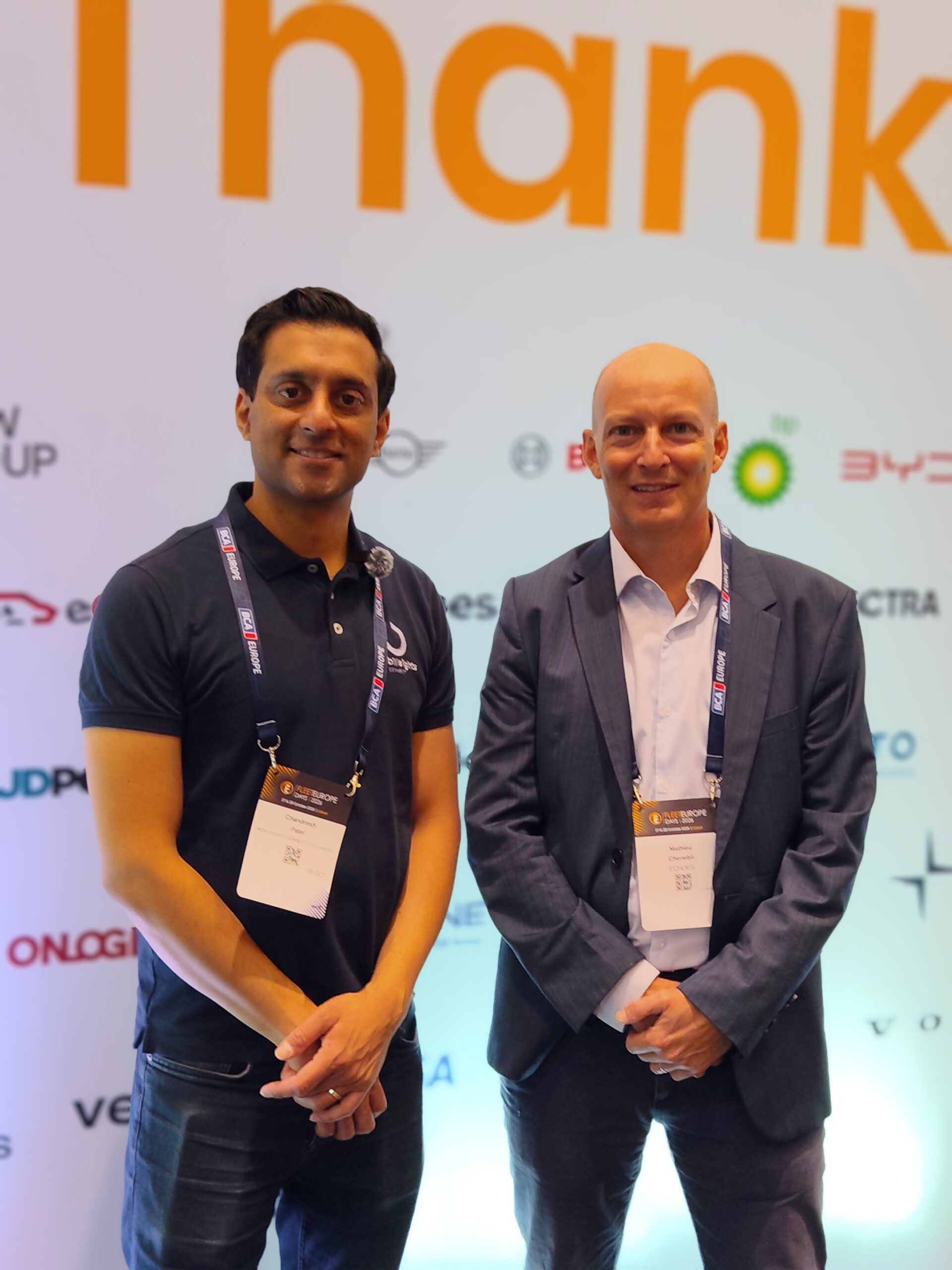
Mobilisights Connect the Stellantis ‘data business unit was the first OEM to open its connected-vehicle data to Echoes. At Fleet Europe Days in Lisbon, we sat down with Chandresh Patel, CEO of Mobilisights Connect, to ask why OEMs are now building fleet data services themselves, and what that means for the people who run fleets.
Mobilisights Connect is the Stellantis data business unit that makes connected-vehicle data from the group’s brands available to fleets and their partners. Echoes has worked with Stellantis, now through Mobilisights, for several years, and that partnership is where our OEM-native approach first proved itself.
We asked Chandresh four questions. Here is what he told us, lightly edited for reading.
Why are OEMs developing fleet data services?
For Chandresh, the answer starts with the customer, not the car.
“We follow the customer. For the fleet customers that we interact with, we see more and more of them requesting or leveraging the services that we provide to help them improve their business, whether it’s their end customers, their cost of ownership or maintaining their vehicles’ uptime.”
Fleets are asking for this data because it changes how they run their business. Chandresh also sees a clear reason for the manufacturer to be the one providing it.
“It’s very beneficial for the OEM to directly provide that service, for the richness and quality of the service, the diversity of services that we can provide, and the confidence and security of working directly with the vehicle manufacturer.”
That last point matters more than it might seem. When the data comes straight from the manufacturer, a fleet knows where it comes from, how it is collected and who is responsible for it.
Why Echoes?
We asked Chandresh what makes the partnership work. His answer was about shared conviction more than technology.
“Echoes is a wonderful partner of ours, and the primary reason is that they fully believe in the same strategy as OEMs like Stellantis and Mobilisights Connect: directly working with clients and fleets that use OEM data. So we can work very closely to provide that service, and save cost and time versus having to go to a hardware or dongle model.”
Echoes was built on OEM data from day one, so there was never a hardware business to protect. That made it easy to agree on the direction. Chandresh described the result as an alignment that is useful to everyone involved: the customer, Echoes and the OEM.
Why OEM data rather than aftermarket devices?
Chandresh didn’t dismiss aftermarket devices for every use case.
“To be clear, there may be aftermarket devices that make sense for a variety of reasons. But from an OEM perspective, if we can provide the data directly to a fleet rather than having to use a dongle, we can save both time and cost for fleets.”
The difference shows most clearly on the day a vehicle joins the fleet. With a device, someone has to book the vehicle into a depot, fit the unit and hope it stays where it was put. With OEM data, the vehicle is already connected.
“It’s activating a vehicle within a day versus scheduling a depot visit, installing the device and then hoping your driver doesn’t impact, touch or mess with the device by accident. We can save that time and we can save that cost, to make sure the vehicle is on the road as much as possible and as quickly as possible.”
He also pointed to what only the manufacturer can offer, such as controlling a vehicle with remote commands, unlocking the door, for example, directly from the fleet manager’s side. And, as he put it, always with privacy and compliance by design.
What future features can fleet managers expect?
This was the question Chandresh seemed to enjoy most.
“What I love about the OEM data space is that we have a lot of opportunity to provide more and more services directly to our customers and to the industry.”
He gave two examples. The first is richer data than a dongle can capture. OEMs are starting to provide ADAS signals, gathered across different electrical architectures, on top of what fleets get from a dongle today.
The second is remote operations: locking and unlocking doors, controlling engine start-stop in certain countries, and supporting stolen vehicle recovery through the immobilizer.
“A lot of these services are highly complex, but we can provide them to our customers. We provide value that can save them cost, time and money, to be more profitable and serve their needs.”
What this means for your fleet
Three things stood out to us from the conversation.
First, OEM data is no longer a side project for carmakers. Manufacturers like Stellantis are building it into how they serve business customers, because fleets are asking for it.
Second, the practical gains are easy to measure. A vehicle connected from day one is a vehicle that doesn’t need a depot visit, a device or a technician before it starts reporting.
Third, the most interesting part is still ahead. Richer signals and remote operations will only come from the manufacturer, and they will change what a fleet manager can do from a single screen.
At Echoes, that is the work we have been doing from the start: bringing OEM data from nearly 40 vehicle brands into one platform, and now turning it into decisions with Echoes Fleet Agent.
Our thanks to Chandresh and the Mobilisights Connect team for their time in Lisbon.
Want to see what OEM data can do for your fleet? Talk to our team.