
Comment la gestion digitale des véhicules révolutionne votre TCO
Le TCO (Total Cost of Ownership) ou coût total de possession est l’un des indicateurs les plus importants dans la gestion de flotte.
Les entreprises disposant d’un parc automobile doivent optimiser leurs coûts d’exploitation, améliorer leur efficacité et rester compétitives. Pourtant, beaucoup sous-estiment les coûts réels, qui vont bien au-delà du simple prix d’achat du véhicule.
Le TCO comprend non seulement les coûts d’achat ou de location, mais aussi toutes les dépenses liées à l’utilisation du véhicule : entretien, réparations, carburant, assurances, administration et pannes imprévues.
Dans un marché très concurrentiel, des coûts d’exploitation élevés peuvent constituer un désavantage compétitif majeur.
Les solutions de gestion de flotte traditionnelles reposent souvent sur des traceurs GPS physiques et du matériel télématique à installer, entretenir et remplacer. Cette approche est coûteuse, exigeante en main-d’œuvre et risquée.
Un système de gestion digitale des véhicules représente une alternative moderne et rentable, permettant aux entreprises de réduire durablement leur TCO.
Qu’est-ce que le TCO (Total Cost of Ownership) ?
Le coût total de possession désigne l’ensemble des coûts qu’implique un véhicule (ou une flotte) sur l’ensemble de son cycle de vie.
Il va au-delà des coûts d’acquisition et intègre toutes les dépenses directes et indirectes liées à son exploitation.
Composantes du TCO :
- Coûts d’acquisition : prix d’achat ou loyers de location du véhicule
- Coûts d’exploitation : carburant, électricité (pour les VE), pneus, maintenance, réparations
- Coûts administratifs : salaires des gestionnaires de flotte, logiciels de gestion
- Assurance & taxes : coûts réguliers liés à la couverture du véhicule
- Amortissement : perte de valeur du véhicule au fil de son utilisation
Une gestion efficace du TCO permet aux entreprises de réduire leurs coûts et de rendre leur flotte plus rentable.
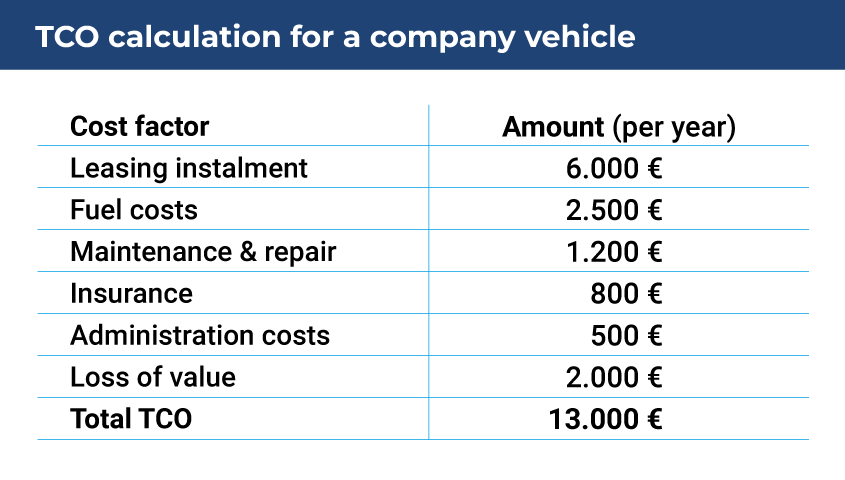
Exemple : Comment calculer le TCO ?
Le calcul du TCO peut varier selon l’entreprise et la taille de la flotte, mais un modèle standard permet de couvrir les principaux postes de dépenses :
Formule du TCO :
TCO = Coûts d’acquisition + Coûts d’exploitation + Coûts administratifs + Assurance & Taxes – Valeur résiduelle
Grâce à la gestion digitale et à l’analyse des données, il est possible d’optimiser durablement plusieurs de ces coûts.
Différences de coûts : directs vs indirects
Il est aussi essentiel de distinguer les coûts directs des coûts indirects dans le calcul du TCO :
Coûts directs :
- Achat ou location
- Carburant ou électricité
- Entretien & réparations
- Assurance
- Taxes
Coûts indirects :
- Perte de valeur dans le temps (amortissement)
- Charge administrative liée à la gestion de flotte
- Pannes et immobilisations
- Coûts d’opportunité liés à une utilisation inefficace
Les coûts indirects sont souvent sous-estimés, mais ils ont un impact significatif sur la rentabilité d’une flotte à long terme.
Différences de TCO selon les types de véhicules
Le TCO varie fortement selon le type de véhicule. Des facteurs comme la consommation, les frais d’entretien ou la valeur résiduelle jouent un rôle clé dans la planification des coûts à long terme.
Comparatif des types de véhicules :
- Véhicules électriques (VE) : coût d’achat plus élevé, mais coûts d’exploitation réduits (entretien et énergie moins chers)
- Véhicules diesel et essence : coûts d’achat plus bas, mais coûts plus élevés en carburant et en entretien
- Véhicules hybrides : compromis avec des coûts d’achat et d’exploitation modérés
- Véhicules utilitaires / poids lourds : coûts d’acquisition élevés, mais durée de vie plus longue et entretien spécialisé requis
Pour les entreprises, il est essentiel de choisir le type de véhicule en fonction des besoins spécifiques de la flotte et de la durée d’utilisation prévue.
Avantages et inconvénients : acheter ou louer ?
Le choix entre location (leasing) et achat a un impact direct sur le TCO. Les deux modèles ont leurs avantages et inconvénients, à considérer selon votre stratégie d’entreprise.
Leasing de véhicules :
- Pas d’investissement initial important
- Paiements mensuels prévisibles
- Possibilité de renouvellement régulier de la flotte
- Peut être plus coûteux si la durée du contrat est mal optimisée
Achat de véhicules :
- Coût initial plus élevé
- Pas d’engagement à long terme envers un bailleur
- Possibilité d’amortissement
- Gestion administrative plus lourde et coûts potentiels de revente
Le leasing convient bien aux entreprises qui ont besoin de flexibilité, tandis que l’achat est souvent préférable pour des véhicules très utilisés sur le long terme.
Smart-TCO : le pilotage intelligent des coûts de flotte
Le Smart-TCO est une approche moderne de gestion du coût total de possession. Il s’appuie sur les technologies numériques et les données en temps réel pour permettre un calcul plus précis et dynamique des coûts de flotte.
Avantages du Smart-TCO :
- Surveillance en temps réel : analyse continue des performances et des coûts des véhicules
- Optimisation dynamique : ajustement des comportements de conduite et des calendriers de maintenance
- Intégration avec les systèmes de gestion digitale : utilisation des données OEM pour des calculs précis
- Rapports automatisés : transparence sur tous les postes de coûts
Les entreprises qui misent sur le Smart-TCO bénéficient d’une prise de décision fondée sur les données et d’un fort potentiel d’économies.
Gestion digitale des véhicules sans matériel supplémentaire
La gestion digitale des véhicules repose sur l’utilisation des données constructeurs (OEM), directement issues de la télématique embarquée.
Cette méthode permet une collecte automatisée et précise de toutes les informations pertinentes du véhicule — sans matériel additionnel ni installation secondaire.
Cette technologie utilise des systèmes cloud et des API pour intégrer facilement les véhicules dans les logiciels existants. Les gestionnaires de flotte bénéficient ainsi d’une vision en temps réel sur l’ensemble du parc : kilométrage, consommation, état de maintenance et défaillances potentielles.
Avantages par rapport aux systèmes traditionnels :
- Aucune installation requise : pas de dispositifs physiques ni de frais de montage
- Précision accrue des données : exploitation directe des données véhicule
- Scalabilité immédiate : ajout facile de nouveaux véhicules
- Compatibilité multi-marques : fonctionne indépendamment du constructeur
Optimisez et réduisez votre TCO avec Echoes
L’offre Echoes comprend :
- CarFleet : pour la gestion digitale de flotte avec données en temps réel et rapports d’émissions de CO₂
- CarLocate : pour la géolocalisation et la protection contre le vol, grâce aux données constructeurs (OEM)
- CarCollect : pour une intégration fluide via API dans les systèmes logiciels existants
Ces solutions permettent aux entreprises de gérer leur flotte de façon plus efficace et de bénéficier d’un large éventail d’avantages.
Aucune dépense liée à du matériel
L’un des grands avantages de la gestion digitale des véhicules est la suppression des investissements en matériel. Les systèmes télématiques traditionnels nécessitent l’achat de traceurs GPS, de capteurs et d’autres dispositifs coûteux et contraignants à entretenir.
Avec les solutions digitales, les données existantes du véhicule sont exploitées — aucun composant additionnel n’est requis. Résultat : économies substantielles et réduction des contraintes logistiques.
Données en temps réel pour une meilleure planification
Les gestionnaires de flotte peuvent consulter et analyser en temps réel les données clés du véhicule, telles que :
- Suivi automatique du kilométrage : pour une facturation précise des contrats de leasing ou de services
- État de maintenance en direct : pour anticiper les pannes
- Codes d’erreur et données de diagnostic : pour planifier les réparations à l’avance
Réduire les coûts de carburant et d’énergie
La gestion digitale permet une analyse détaillée de la consommation. Les entreprises peuvent :
- Analyser les comportements de conduite pour détecter les conduites inefficaces
- Utiliser des tableaux de bord CO₂ pour réduire les émissions et prendre des décisions durables
- Optimiser la gestion des VE en surveillant les niveaux de charge et les données de consommation
Moins de tâches administratives, plus d’efficacité
De nombreuses tâches administratives sont chronophages et sources d’erreurs. L es solutions digitales automatisent de nombreux processus :
- Calculs et rapports TCO en un clic
- Carnets de bord numériques pour la fiscalité et la conformité
- Facturation électronique et gestion automatisée des cartes carburant
La prochaine étape de votre gestion de flotte : CarFleet

La gestion digitale des véhicules offre aux entreprises une alternative moderne, efficace et économique aux solutions de gestion de flotte traditionnelles.
En supprimant les coûts liés au matériel, en exploitant des données en temps réel et en automatisant les processus administratifs, le TCO (coût total de possession) peut être considérablement réduit.
Passez à l’étape suivante et optimisez votre flotte avec Echoes !
FAQ : Ce qu’il faut savoir pour réduire votre TCO
Pourquoi le TCO est-il souvent sous-estimé ?
Beaucoup d’entreprises ne considèrent que les coûts directs d’un véhicule, comme l’achat ou le carburant.
Les coûts indirects — comme les temps d’immobilisation, la charge administrative ou l’amortissement — sont souvent négligés, alors qu’ils ont un impact important sur le coût global.
Comment fonctionne la gestion digitale sans matériel supplémentaire ?
La gestion digitale utilise les données OEM (données constructeurs), extraites directement de la télématique intégrée du véhicule.
Les systèmes basés sur le cloud et les API permettent une intégration fluide avec les logiciels existants, sans avoir besoin d’installer de traceurs GPS ou de capteurs.
Comment la gestion digitale aide-t-elle concrètement à réduire le TCO ?
Grâce à l’analyse des données en temps réel et à l’automatisation des processus, les entreprises peuvent :
- Réduire les coûts de maintenance en intervenant rapidement en cas d’erreurs ou d’usure
- Diminuer les coûts de carburant ou d’énergie grâce à l’analyse de la conduite et à une utilisation optimisée
- Alléger la charge administrative via des carnets de bord numériques et une facturation automatisée
- Éviter les immobilisations en planifiant les réparations et entretiens de façon proactive
La taxe sur les véhicules influence-t-elle le TCO ?
Oui, la fiscalité automobile peut avoir un impact important sur le TCO, notamment pour les grandes flottes.
Facteurs influençant la fiscalité des véhicules :
- Émissions de CO₂ : les véhicules propres sont souvent favorisés fiscalement
- Type de véhicule : les véhicules électriques bénéficient d’avantages fiscaux dans de nombreux pays
- Cylindrée et puissance moteur : les véhicules puissants sont généralement plus taxés
Choisir les bons véhicules permet donc de réduire non seulement les coûts d’exploitation, mais aussi de bénéficier d’avantages fiscaux.