No more stops, no more barriers, no more fumbling for change: barrier-free tolling is gradually becoming the norm on European roads. For drivers, it’s a real convenience. For fleet managers, car hire companies and leasing firms, however, this development shifts a problem rather than solving it: the bill doesn’t disappear; it simply arrives later with no indication of who was driving, under which contract, or in which country.
This is what might be called the toll visibility paradox: the smoother the driving experience becomes, the heavier the administrative burden upstream becomes for the fleet operator.
Barrier-free tolling: a Europe-wide transformation
This trend is by no means trivial. Over the past ten years, barrier-free toll infrastructure has expanded from around 15 per cent to 45 per cent of the total network in Europe. Over the same period, the number of cities implementing urban access charging or low-emission zones has risen from fewer than 20 to over 100. Revenue from tolls and road charging in Europe, which stood at around €30 billion ten years ago, now stands at around €50 billion, and is on track to reach €90 billion by 2035.
These figures come from research MapUp has been building over the past several years, tracking the expansion of barrier-free tolling and road-charging schemes across Europe.
This trend is accelerating further with new schemes: in the Netherlands, a kilometre-based toll for heavy goods vehicles came into force on 1 July 2026, replacing the Eurovignette. In Lithuania, a national toll system for heavy goods vehicles which can be managed entirely via smartphone and requires no on-board device was awarded to an operator in early 2026, foreshadowing what several analysts predict for 10 to 15 European countries by 2030: a fully digital toll system requiring no hardware to be installed in the vehicle.
For fleets operating across more than one country which is the norm for short-term hire, leasing or road haulage, this means having to deal with different systems, currencies, billing cycles and regulations, often on the same journey.
Why barrier-free tolling is becoming a problem for fleets
For an individual motorist, barrier-free tolls are a simplification. For a fleet, the opposite is true: the problem does not disappear; it simply shifts from the driver to the fleet manager. Two specific challenges arise.
“Barrier-free tolling didn’t eliminate friction. It transferred it from the motorway to the fleet’s back office,” says Katie Mahlawat, CEO of MapUp.
1. The billing timeframe
Ideally, a car hire company should bill the toll at the time the vehicle is returned. However, with barrier-free tolls, the toll statement may arrive several days, or even several weeks later. For a clientele of holidaymakers or international travelers, this often means an expired credit card, a customer who cannot be contacted, or a journey that has been forgotten resulting in a disputed invoice or one that is never collected.
“If we can’t bill the customer the moment the vehicle is returned, we may not be able to reach them again, charge their card or recover the toll at all,” says Chase Collins, Internation Sales Manager at Echoes.
2. Data reconciliation
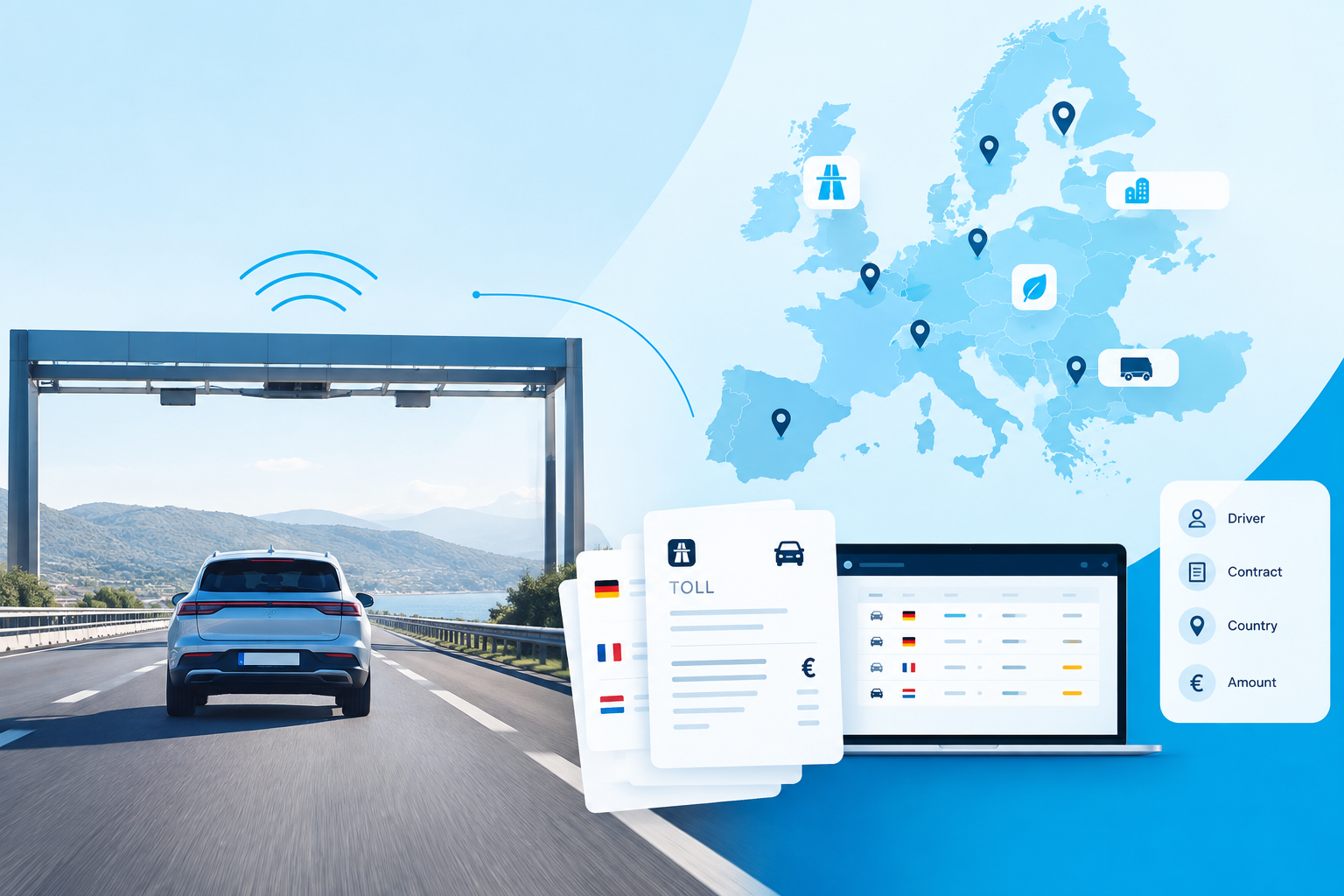
A toll invoice never mentions the driver’s name or the hire contract number: only a registration number and an amount. If the vehicle has travelled through several countries a common occurrence in Northern Europe or in border regions, the fleet manager must manually cross-reference invoices from several toll operators with the booking data to work out who was due to pay what.
This manual work comes at a real cost: within the sector, it is estimated that between 15% and 20% of toll charges are never recovered when the process remains manual not because of any bad faith on the part of customers, but simply because the invoice arrives too late.
An issue that goes beyond short-term hire
The problem is not limited to rental companies. It affects any fleet where one party pays, advances or re-invoices tolls on behalf of another:
- Mixed-use corporate fleets: an employee uses a company car for both business and personal purposes, but it is still necessary to distinguish between journeys for the purposes of re-invoicing or reporting (benefit in kind in France, CSRD, carbon footprint).
- Mobile technicians and home-based vehicles: an issue that is already central in the Nordic countries, where Chase Collins sees the business/personal breakdown of tolls come up constantly with fleet customers.
- Hauliers and self-employed drivers: they often pay tolls up front and must be reimbursed accurately, journey by journey.
In all these cases, the underlying question is the same: which journey belongs to whom, and who should pay?
A real-world example: an Echoes × MapUp customer story
This challenge is not merely theoretical. It is exactly what one shared Echoes and MapUp customer, a Swedish rental fleet, experienced firsthand. In just one month, a rental fleet of around 1,700 vehicles in Sweden generated nearly €36,000 in tolls to be allocated, invoice by invoice, to the corresponding rental contracts. This is the amount that the operator must be able to allocate and recover correctly, month after month, country after country, to avoid losing revenue.
When scaled up to a larger fleet or one operating across several European markets, the financial stakes quickly become significant: with a 15-20 per cent loss from a manual process, this is not a negligible figure, but a real and recurring portion of turnover.
How the Echoes × MapUp partnership came together
The collaboration started with a customer need rather than a sales pitch. Echoes had a strong opportunity with a Swedish rental fleet that had tested well on vehicle eligibility, but the fleet also needed a way to solve its toll charges. Chase Collins began researching toll intelligence providers and came across MapUp.
“I quickly realised this was not just a sales opportunity, it was a partnership opportunity,” says Chase Collins. “Within one or two weeks we had vehicles connected and testing. By the end of December the test was finalised, and by early April the whole Swedish fleet was live.”
On MapUp’s side, the decision to work with Echoes came down to accuracy and to the direction the market is heading.
“Many providers can reach 85 to 90 per cent accuracy, which is fine for planning but when a fleet is billing customers or reimbursing drivers, a 10 per cent error can become a very large amount of money,” explains Katie. “Echoes stood out because the team was genuinely willing to solve the customer’s problem, and because they’re building on native OEM data, which is where telematics is heading rather than where it’s been.”
The solution: cross-referencing OEM vehicle data with toll intelligence
The good news is that this reconciliation issue can be resolved automatically, without adding any additional on-board units to the vehicles.
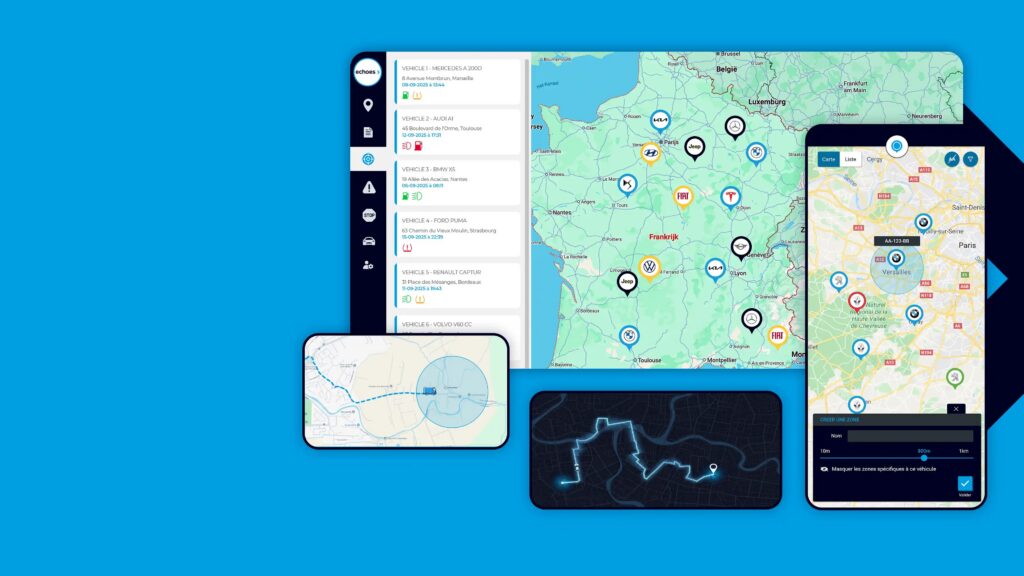
By combining manufacturer data (OEM telematics, already utilised natively by a fleet management platform such as ECHOES) with TollTally, MapUp’s toll calculation engine based on actual GPS journeys, it becomes possible to automatically link each toll charge to the correct hire contract, the correct driver and the correct journey regardless of the country traversed.
The two companies play complementary roles: Echoes provides secure, scalable access to native OEM vehicle data, while MapUp transforms that journey data into near real-time toll and road cost intelligence through TollTally.
In practical terms, this approach enables:
- invoicing in near real time, rather than a delay of several weeks
- the elimination of manual reconciliation between toll invoices and hire contracts
- automatic distinction between business and personal journeys for corporate fleets
- no need to install or maintain additional equipment on the vehicle, including in mixed, multi-manufacturer fleets.
As the Swedish rollout shows, technical and regulatory complexity across multiple countries is no longer an obstacle to this level of automation.
Which European markets are most affected by barrier-free tolling?
Demand for this type of solution is directly proportional to the density and complexity of road charging schemes in each country. Beyond the Nordic countries, several European markets are particularly affected: Portugal, France, the Benelux countries, the Baltic states and Hungary, as well as areas where cross-border journeys are frequent, such as Eastern Europe and Switzerland. Every new road charging scheme, whether it is a kilometre-based toll, a low-emission zone or a congestion charge, further reinforces the need for automated and centralised management of road costs.
Looking ahead: from connected vehicles to connected decisions
“The industry is moving from connected vehicles to connected decisions,” says Katie, CEO of MapUp.
Barrier-free tolling is only the beginning. As Europe continues moving towards congestion charging, low-emission zones and distance-based road pricing, the real opportunity is not simply collecting more vehicle data but turning that data into operational decisions in real time which is precisely what the Echoes × MapUp partnership sets out to do.
FAQ: Barrier-free tolling and fleet management
What is barrier-free tolling (or free-flow tolling)?
It is a motorway toll system that replaces physical barriers with gantries fitted with cameras and sensors. These gantries identify each vehicle by reading its number plate or electronic toll tag and automatically calculate the amount due, which is paid by the driver at a later date.
Why does barrier-free tolling cause a problem for fleets, when it makes life easier for drivers?
Because the toll invoice itself doesn’t disappear: it simply arrives later, without any indication of the driver or the associated hire contract. For a fleet, this creates manual invoicing and reconciliation work that didn’t exist with traditional barriers.
How can a car hire company bill its customers for tolls without spending too much time on it?
By automating the reconciliation of the vehicle’s journey data (position, mileage) with the toll notices received, rather than doing it manually, invoice by invoice. This is precisely what is made possible by cross-referencing OEM telematics data with a dedicated toll calculation engine.
Does barrier-free toll collection apply only to certain European countries?
No. The trend is widespread: barrier-free toll infrastructure has grown from around 15 per cent to 45 per cent of the European network in ten years, and markets such as the Netherlands, Portugal, the Baltic states and Hungary are developing increasingly complex and automated road charging systems.
Why are corporate fleets affected, and not just rental companies?
As soon as a vehicle is used for both business and personal purposes, or a company advances toll charges for an employee or a subcontractor, the same reconciliation issue arises: which journey, at which toll point, for what purpose.